Seating
Seating Chart Layouts That Work for Different Reception Styles
Long banquet tables, rounds, cocktail-style or a mix: which wedding seating chart layout suits your reception style, venue and guest list, with the day-of practicalities covered.
By Henry Schofield
· 14 min read
Here's the thing about seating charts: everyone starts with Pinterest and ends up with a floor plan headache. Wrong order. The layout you pick decides how your night actually feels, who talks to who, and whether your nanna can see the first dance without craning her neck like she's at a tennis match. So before you fall for a moodboard full of dried flowers and taper candles, sort out the shape of the room first.
Wedding seating chart ideas are really about the tables. Get the table layout wrong for your reception style and no amount of calligraphy fixes it. As one planner told me after a particularly chaotic barn wedding: she once watched a bride spend six months choosing between two shades of blush pink napkins, then spend six minutes deciding the table layout, and then spend the whole reception fielding complaints about who could and couldn't see the cake cutting. Measure twice, seat once.
Long banquet tables: the communal crowd-pleaser
Long tables (or "feasting tables" if you want to sound like you've read a bridal magazine) are the ones you see in every marquee wedding and barn venue from the Hunter Valley to the Yarra Valley. One continuous run, sometimes two or three parallel to each other, guests down both sides.
When it suits: rustic, relaxed, marquee, barn, vineyard. Anywhere with an open floor plan and a bit of rawness to the aesthetic. Long tables look sparse in a formal ballroom; they look right at home under fairy lights and exposed beams.
Conversation flow: it's communal by design. You can talk to the people directly across from you and beside you, comfortably. Talking to someone six seats down means yelling over the centerpiece, so don't expect the whole table to chat as one group. Think of it less as one conversation and more as four or five overlapping ones, like separate radio stations on the same frequency.
Sightlines: depends entirely on table orientation. Run the tables perpendicular to the top table or dance floor, and everyone's got a side-on view, which actually works better than you'd think, since nobody's craning around a guest's head to see the cake cutting. Run tables parallel to the action and the people at the far end are watching a dance floor the size of a stamp.
Guest list implications: long tables force groupings of 10 to 14 people down each side, which means more thought about who ends up next to who. There's no "corner" to hide the awkward cousin, and everyone's exposed, elbow to elbow, for the whole reception. Plan those seat pairings with care, because a bad seatmate on a long table is stuck there for three courses, not just until the entrée plates get cleared. It's a bit like being seated next to a stranger on a long-haul flight: charming for the first twenty minutes, then you're checking how many hours are left.
Round tables: the classic for a reason
Round tables of eight to ten are still the most-booked layout in the country, and that's not an accident. Circles are democratic, with no head of the table and no awkward "corner seat," and everyone's roughly equidistant and can actually hear each other.
When it suits: basically everything. Ballrooms, hotel function rooms, marquees, backyard weddings. It's the white t-shirt of reception layouts: goes with anything.
Conversation flow: best in the business. Groups of eight to ten at a round table can genuinely have one shared conversation, or split into two smaller chats without anyone feeling excluded, compared to a long table where the people at opposite ends might as well be at separate weddings.
Sightlines: here's where round tables get tricky. Position them badly and half your guests spend the reception looking at the back of someone's head instead of the couple. Angle each table slightly toward the dance floor or top table rather than lining them up in a strict grid, and you fix most of the problem before it starts.
Guest list implications: round tables group people in clusters of eight to ten, so you're essentially building ten little dinner parties instead of one long feast. That's a gift and a curse. It's easier to seat, say, "the netball team" together as a self-contained unit; it's harder to blend two friend groups who don't know each other, since there's no natural overlap point like there is on a long table. The wedding planner loved round tables for one simple reason: no arguing about who sat at the head of them.
Mixed rounds and a long head table
This one's the hybrid: round tables for guests, one long table up front for the wedding party (or just the couple, these days, since not everyone wants ten bridesmaids staring out at the room like a panel of judges).
When it suits: medium to large weddings that want formality without going full ballroom-and-chandelier. Common in renovated woolsheds, function centers, and reception venues with a defined "stage" area.
Conversation flow: guests get the round-table benefit. The head table crew, meanwhile, is stuck talking to whoever's beside them, since a long table only lets you chat sideways. If your bridal party doesn't all get along, this is either a fun social experiment or a slow-motion disaster.
Sightlines: this layout genuinely earns its keep here. A long head table on a slight platform, or even just at the front of the room, gives every round table an unobstructed view. It's the closest thing to guaranteed good sightlines that reception design offers.
Guest list implications: you're now making two seating decisions instead of one. Who's on the head table (and does that include partners, parents, the flower girl's mum who did all the flowers for free?) is its own political minefield, separate from the general guest seating.
Cocktail-style: minimal seats, maximum movement
No formal dinner, a handful of lounges and high tables scattered around, guests standing and mingling with a canape in one hand.
When it suits: shorter receptions, evening-only events, city rooftop venues, or couples who genuinely hate the idea of assigned seating. Also handy if your venue's a weird shape that doesn't take table rows well.
Conversation flow: the most fluid option going. Guests move, mix, and meet people they'd never sit next to at a formal dinner. Downside: your elderly relatives and anyone in heels they regret wearing will want somewhere to actually sit down for more than five minutes.
Sightlines: easy, honestly, since there's no fixed seating blocking anyone's view. Just make sure there's a clear spot for speeches and the first dance that doesn't need a guest to abandon their canape mid-bite to go find it.
Guest list implications: almost none, which is the whole appeal. No seating chart, no place cards, no 11pm phone call from your mum asking why she's sitting next to your ex-boyfriend's parents. You still might want a handful of reserved seats for older guests or immediate family, so nobody's grandfather is standing for three hours straight.
Outdoor and marquee specifics
Marquees and outdoor spaces come with their own physics. Ground isn't always level, and table legs need packers more often than you'd think, especially on grass after rain. Wind is a genuine seating consideration too: table plans, place cards, and any paper signage need weighting or they'll end up in the neighboring paddock. Marquee poles, meanwhile, have never once RSVP'd "yes" to a wedding, yet somehow they always show up right where you wanted table six.
Long tables tend to suit marquees structurally, since the pole placement in a traditional marquee often dictates a run-based layout anyway. Round tables work fine in clearspan marquees (the ones without internal poles), but check with your marquee supplier before you commit to a floor plan, because pole positions can turn a lovely round-table layout into an obstacle course.
Lighting matters more outdoors, too. Fairy lights and festoon lighting look gorgeous, but they also need to actually reach the areas where guests read their table numbers.
Small weddings under 60 vs large 120+
Small and large weddings run on different logic entirely; the whole approach changes with the guest count.
Under 60 guests: you can often get away with one long table, or two rounds, meaning nearly every guest is within easy earshot of the couple. Sightlines barely matter, since nobody's more than a few meters from the action. The seating "chart" might just be a friendly suggestion rather than a formal plan.
120+ guests: now you're managing a small stadium. Sightlines become genuinely important, since guests at table 14 near the back door shouldn't feel like they're watching the wedding through a periscope. You'll likely need multiple table shapes to fit the room efficiently, a proper chart or display (a whisper alone won't cut it), and probably a numbering system that makes sense, walking table 1 through table 15 in a logical path rather than scattering the numbers like a lottery draw.
Match the layout to your floor plan and guest list first
Here's the part everyone skips, and it's the part that actually matters. Before you decide long tables are "your aesthetic," get your venue's actual floor plan and actual final numbers (or a close estimate) and do the maths.
Ask your venue coordinator, not Pinterest, these questions:
- How many round tables of eight, or long tables of a set length, physically fit the room with dance floor, bar, and DJ booth included?
- What's the maximum table count before the back row loses sightlines to the couple?
- Does the room's shape (long and narrow, square, L-shaped) favor one layout over another?
- How many "awkward" seats, meaning ones facing a wall, a pole, or the kitchen doors, does each layout create?
A layout that looks stunning in a styled photoshoot with 40 chairs might physically not fit your 140-guest list in your particular function room. Venues have hard limits, so find them before you fall in love with a table shape, not after your stationer's already printed 18 table numbers.
Day-of practicalities: how guests actually find their seat
Nobody photographs this part, but it's the bit guests actually interact with. Three main options.
Escort cards: individual cards, one per guest, usually alphabetical on a table near the entrance, telling each person which table they're at. Fast for guests to find, but takes real setup time and a decent-sized table or wall to display them on.
Seating chart display: one big board or sign, guests scan it for their name, find their table. Looks great in photos, works well for guest lists under about 100. Beyond that, it becomes a crowd scrum of people squinting at tiny font, so bump up the text size or split it into multiple boards by surname.
Digital lookup: a QR code or wedding website link guests can check on their phone before or during arrival. Zero paper, zero crowding, but it does rely on decent phone reception at the venue and guests actually bothering to check it beforehand rather than at the door with 50 people banked up behind them.
Whichever one you use, put it somewhere with actual foot traffic and actual light. A gorgeous seating chart tucked behind a floral arch that nobody can read is just an expensive piece of art at that point.
So Which Layout Should You Actually Pick?
Best for a relaxed, rustic or marquee reception: long banquet tables. They suit the aesthetic, they photograph beautifully, and the communal feel does half the work of making the room warm.
Best for a guest list where half the room doesn't know the other half: rounds. Groups of eight to ten can hold one conversation, so you can seat a self-contained cluster together without stranding anyone.
Best for guaranteed sightlines above 120 guests: rounds with a long head table. It is the only layout that reliably gives every table a clear view of the speeches without a platform.
Best for a short evening reception or an awkwardly shaped room: cocktail-style. No seating chart, no place cards, and it fits rooms that refuse to take neat table rows. Just keep a handful of reserved seats for older guests.
How WedBuild Builds the Layout
Choosing the layout is the easy half. The hard half is that every one of these choices changes the seat count, and the seat count changes who fits where, which is why couples redraw a plan four times when the layout and the guest list live in different places.
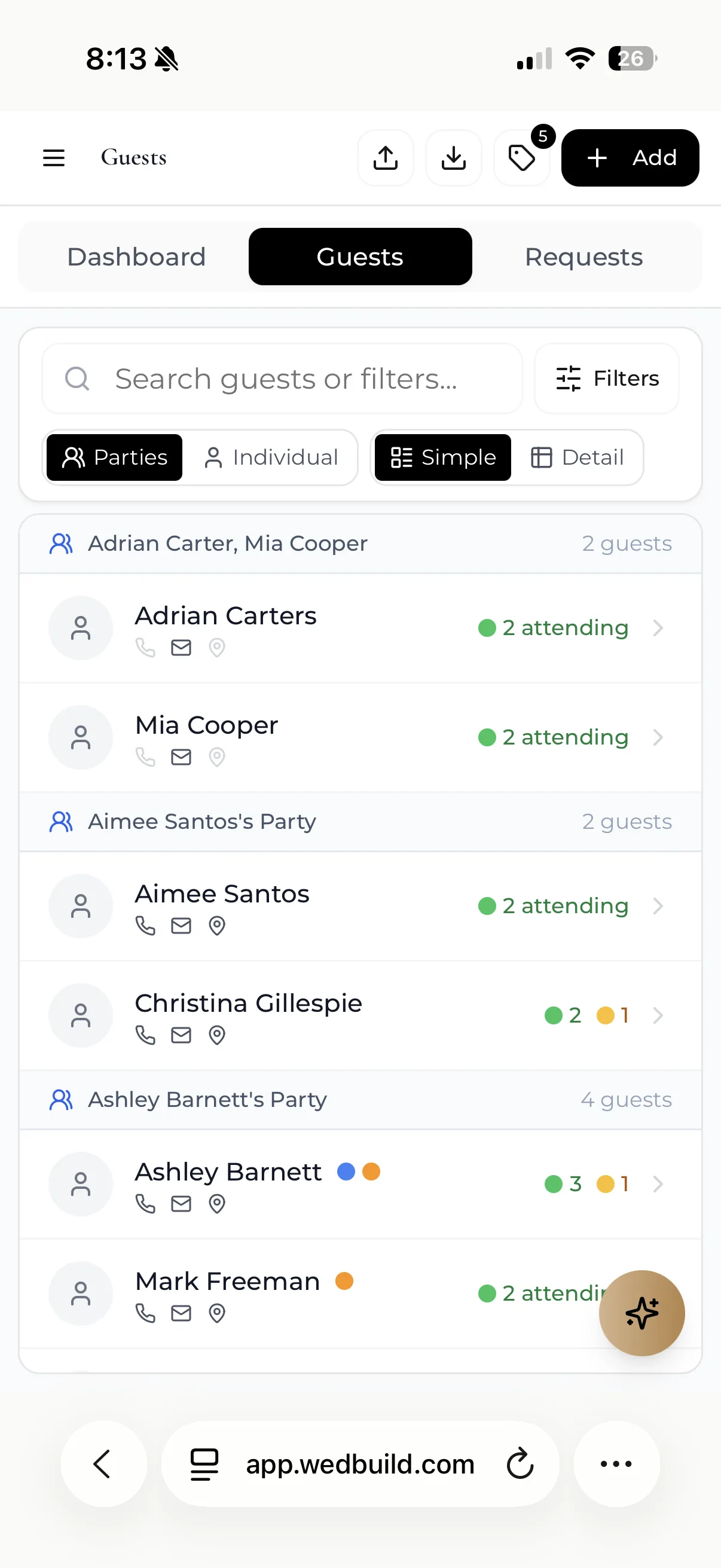
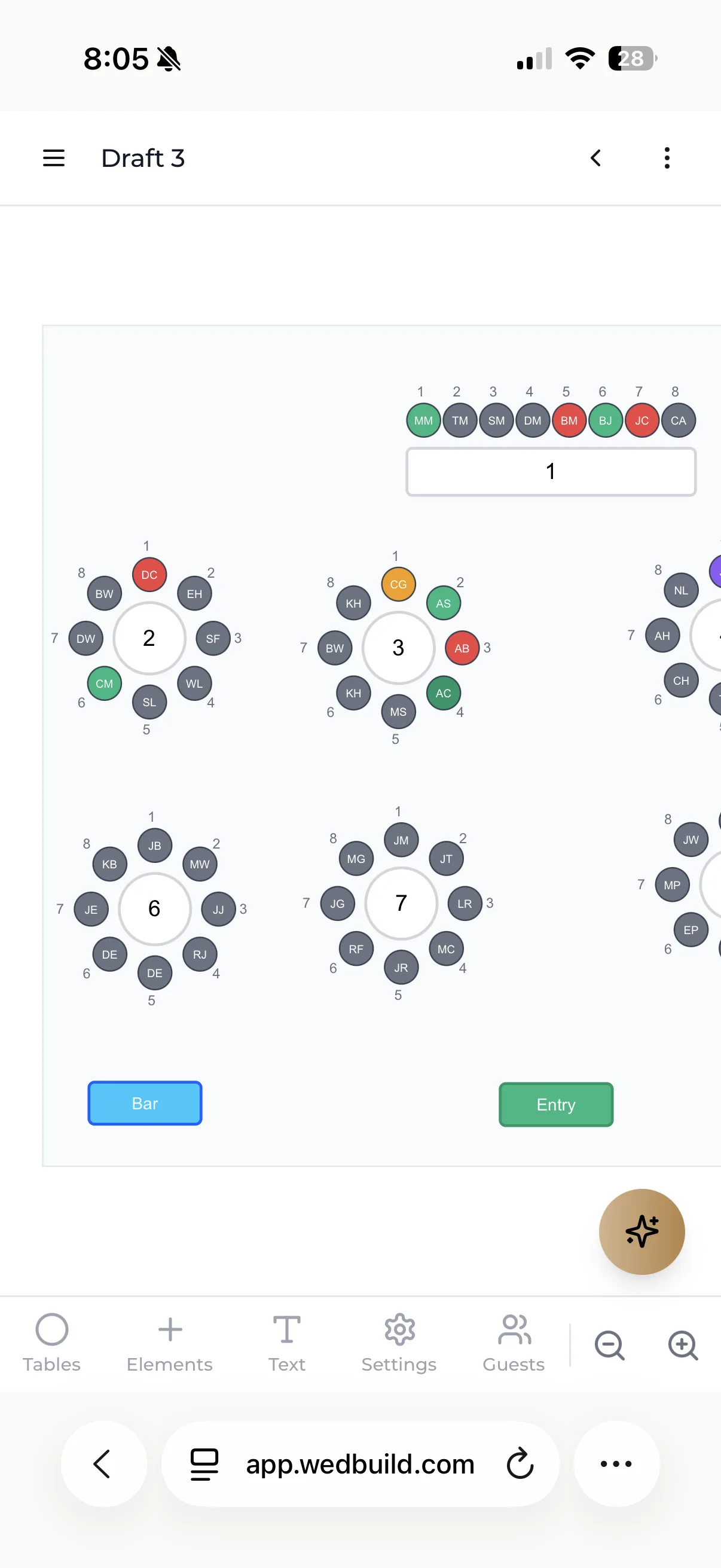
In WedBuild the seating chart and room designer sit on top of the guest list. Drag in a round that seats ten and it shows ten seats; swap the room to long tables and the guests you have already placed move with it rather than vanishing. You can keep several versions of the same room side by side (rounds, long tables, a mix) and compare them before committing, and dietary requirements captured at RSVP follow each guest to their seat instead of being reconciled by hand the week of the wedding.
The practical details, in AUD: the free plan covers weddings up to 50 guests with the guest list, wedding website, online RSVPs and checklist. The drag-and-drop seating chart comes with Standard (A$99, paid once). Pro (A$199, paid once) adds the visual room designer, printable table cards with a dietary legend, and the QR Find My Seat lookup so guests can find their table on their phone at the door. Both are one-time payments, not subscriptions, and WedBuild is built in Australia.
Before you go
Frequently asked questions
How many guests per table?
Round tables typically seat eight to ten comfortably. Long tables usually work out to around 10 to 14 per side depending on table length and chair width. Check your venue's actual table dimensions rather than assuming; an "8-seater" round from one hire company can be noticeably tighter than another's.
Can you mix table shapes in one reception?
Yes, and plenty of weddings do, combining rounds for guests with one long head table, or mixing round and long guest tables to fit an awkward-shaped room. Just keep the mixing intentional rather than accidental; a room with three different table shapes scattered at random tends to look unplanned rather than eclectic.
Do you need a head table?
Plenty of couples now do a sweetheart table (just the two of them), sit with their wedding party at a round table like everyone else, or skip a designated top table altogether at cocktail-style events. A head table is a formality tool, not a rule, so use it if it suits your reception style and skip it if it doesn't.
Whichever layout you land on, the mechanics are the same: import your guest list once, set your tables to match the room, and drag people into place. WedBuild’s seating chart does exactly that. It's connected to your RSVPs so dietary requirements travel with every name, with a day-of Find My Seat QR lookup so nobody hovers at the door. The chart comes with Standard and Find My Seat with Pro, both paid once, and every new couple gets seven days of the Pro tools free to try them. For the people-politics half of the job, our step-by-step seat assignment guide picks up where the layout leaves off.
What is the best app for planning a wedding seating chart?
The thing that matters is whether the seating chart is connected to your guest list, because that is where the re-work comes from. A chart you build separately has to be redone every time numbers move. WedBuild links the two, so RSVPs and dietary requirements flow into the seats automatically. The drag-and-drop chart is included from Standard (A$99, paid once) and the visual room designer from Pro (A$199, paid once).
Can you make a wedding seating chart for free?
For smaller weddings, yes. WedBuild's free plan covers up to 50 guests and includes the guest list, wedding website, online RSVPs and checklist. Drag-and-drop seating comes with Standard at A$99 (a one-time payment rather than a monthly subscription), which also removes the guest limit.
How do guests find their seat on the day?
Three options, and they scale differently. Escort cards are fastest for guests but slowest to set up. A single seating chart display looks best in photos and works well under about 100 guests, after which it becomes a scrum. A QR lookup guests check on their phone removes the queue entirely (WedBuild's Find My Seat does this on the Pro plan), but it depends on the venue having usable phone reception, so it is worth pairing with a printed board as a fallback.

Written by
Henry Schofield
Co-founder, WedBuild
Henry is the co-founder of WedBuild and a chartered accountant who's spent his career helping Australian businesses get their numbers right. After his own wedding budget sprawled across three different spreadsheets, he built WedBuild's budget planner: designed by an accountant, for couples who'd rather not become one.