Guest List & RSVPs
What to Do When Wedding Guests Don't RSVP in Australia: A Reminder Schedule, Scripts and a Cut-Off Rule
Work back from your caterer's deadline with three reminders and a firm cut-off.
By Elise Schofield
· 11 min read
Photo by Vitaly Gariev on Unsplash
When wedding guests don’t RSVP, the answer is a deadline-led process. For an Australian wedding, base that process on the date the caterer needs final numbers. Work backwards, send three reminders, and make the consequence of silence clear. Treat missing replies as a logistics problem.
Why the caterer's final-numbers date is the only deadline that actually matters
Most Australian caterers require a final guaranteed guest count one to two weeks before the wedding. Couples typically pay for that number even if guests drop out. That makes an unresolved invitation a possible cost. The guarantee is the pressure behind the chasing.
An RSVP date that feels polite may leave no time between getting replies and sending in the numbers. Yet that gap is where the follow-up happens. Non-response is a normal feature of a guest list, so your timeline needs to allow for it. Read your contract, find the final-numbers date, and work backwards from there.
Why guests go quiet, and why that matters for how you follow up
Zarife Hardy of the Australian School of Etiquette says guests may fail to reply because they are too busy, don’t think of others or feel the strain of the cost of living. Silence alone doesn’t tell you which one applies. A digital invitation can sit unread in a crowded inbox, or get filed mentally under “later”. A guest may also be waiting on annual leave, travel costs or a family conflict. They don’t know yet, and saying nothing feels easier.
The right follow-up depends on the obstacle. Someone who forgot needs a nudge, while someone worried about cost needs an easy way to say no. In some Australian families and multicultural communities, an invitation comes with an assumption that the guest will attend unless they say otherwise. Those guests need a warm, direct chat about letting you know whether they are coming.
How to build your RSVP timeline by working backwards from your contract
Write down the contractual final-count date before choosing your reply-by date. Then put the RSVP deadline at least two to three weeks earlier. That buffer has a job to do. It gives you time to chase missing replies, count the guests who have said yes and get in touch with the venue without every unanswered message becoming an emergency.
For example, if your wedding is on 15 March and the caterer needs numbers by 1 March, an RSVP deadline of 8 February leaves room for follow-up. Invitations could go out in early December. The sequence is deliberate. Choose the date you need answers first, then give guests enough time before it to make their plans. Destination or interstate travel needs extra weeks.
Australian RSVP deadlines commonly fall six to eight weeks before the wedding. Although six to eight weeks out is a standard invitation window, it cannot support an RSVP deadline at the same point. Send earlier where your chosen deadline requires it. Once the numbers are confirmed, work on the seating chart and, shortly after, place cards can go ahead.
A three-touch reminder schedule anchored to your RSVP deadline
The first touch goes three weeks before the RSVP deadline to everyone who hasn’t answered. Keep it warm and low-pressure. Its purpose is to catch forgotten invitations. The tone should be gentle and celebratory, with a clear way to reply. Guests who have already responded do not need another message.
The second touch goes one week before the deadline, again only to non-responders. This one can be more direct. Explain that you’re finalising the headcount, and consider a personal text for a small wedding. Digital RSVPs with automated reminders get a strong response rate, so it helps to get in touch personally with those who still haven’t replied.
The third touch goes two days before the deadline and names the reply-by date explicitly. Be firm, specific and free of blame. For close friends and your highest-priority, or Tier One, guests, use a direct message. Keep households without email on a separate list for WhatsApp or SMS from your own phone. An email reminder cannot reach an address you don’t have.
Three reminders before the deadline are enough. More creates noise. Publisher internal data shows that a structured Gentle, Friendly and Firm reminder plan resolves most non-responses before the deadline, leaving a small group for direct follow-up. The connected tool discussed below offers this schedule on its Standard and Pro plans. Automation handles the routine nudges, while personal judgement remains with you.
Copy-paste scripts for each reminder stage
Use the gentle message three weeks out for guests who may simply have forgotten. Fill in the placeholders before you send the message, including the wedding date and reply link.
“Hey [Name]! Just a friendly heads-up: we haven't received your RSVP for our wedding yet. We'd love to know if you can celebrate with us on [Date]. You can reply here: [link]. Hope to see you there! 🎉”
Use the friendly message one week out. It suits a batch reminder, but can also go as a personal message to a smaller list.
“Hi [Name], we're getting close to finalising our guest count and noticed we haven't heard back from you yet. Would love to know if you're able to join us on [Date]. The RSVP link is here: [link]. Thanks so much!”
Use the firm message two days before the deadline. The caterer’s date explains the constraint without making the guest’s silence a personal accusation.
“Hi [Name], our RSVP deadline is [date] and we're sending final numbers to the caterer on [final-count date]. Are you able to make it? Either way is completely fine, we just really need to know. [link]”
For persistent non-responders, call two to three days after the deadline. Keep the start of the call short and give them time to answer.
“Hi [Name], it's [Your name]. I'm just calling about our wedding on [date]. We're finalising the guest count this week and wanted to check whether you'll be able to join us.”
The cut-off rule: how to count someone out and communicate it without drama
After failed attempts through both a reminder and direct personal contact, silence needs a defined consequence. Count the guest as not attending, but communicate that assumption in writing before enforcing it. Don’t quietly erase them from the list. Hardy recommends putting “if we don't hear back via RSVP we will assume you are not able to make it” on invitations. The same principle applies at the cut-off.
For a close friend or Tier One guest, make a personal call first, especially if the silence is out of character. Then send a final written message with an explicit deadline.
Are you in for [date]? Either answer is completely fine, the caterer just needs a final count by [date].
For Tier Two and Three guests, including acquaintances, colleagues and your extended network, apply the hard cut-off and release the spot once that deadline passes. Family expectations can complicate this. Where silence is taken to mean a guest is coming, reach out to them personally more often before the cut-off. Once the cut-off has passed, send the numbers to the caterer without waiting another week.
What to do when a late reply arrives after numbers are locked
A late “yes” is a count-change request. Start with the contract, then contact the caterer or venue before promising the guest a place. Some caterers let couples add a few guests up to a few days before the wedding, while others stick to the number they were given. The answer depends on your agreement.
If a Tier One guest can be added, confirm the spot with the caterer, update the seating chart, then notify the guest. Keep that order intact. If an addition isn’t possible, you aren’t obliged to find a seat. A kind, honest response is enough, such as “we've already submitted final numbers to the caterer and unfortunately can't make changes at this point”.
A late cancellation creates a different problem. Illness, travel disruption and personal circumstances mean some confirmed guests will drop out in the final two weeks. Treat that as a planning risk. The catering guarantee typically means you still pay for their spot. Update the seating chart when the change is confirmed so the day’s arrangements reflect who is actually coming.
Comparing three approaches to tracking and chasing RSVPs, and which suits your wedding
A spreadsheet and group chat can work well for a guest list under 30–40 people, especially when you know everyone personally and are comfortable sharing a document. Small can genuinely be simpler. But each time a reply changes, you have to update it by hand, send reminders yourself and check dietary requirements against the seating chart. Choose this approach when that workload is manageable. It is less appealing when the list gets longer.
Paper reply cards with a return envelope suit guests who like to send and receive things by post, especially at weddings with many guests in their sixties and beyond. They remove the technology barrier entirely. However, traditional paper RSVPs without follow-up reach noticeably fewer guests, so phone or in-person chasing still needs a place in the plan. Replies also need to be recorded as cards arrive. Paper is a legitimate choice where family preferences favour it, and it can supplement digital tools.
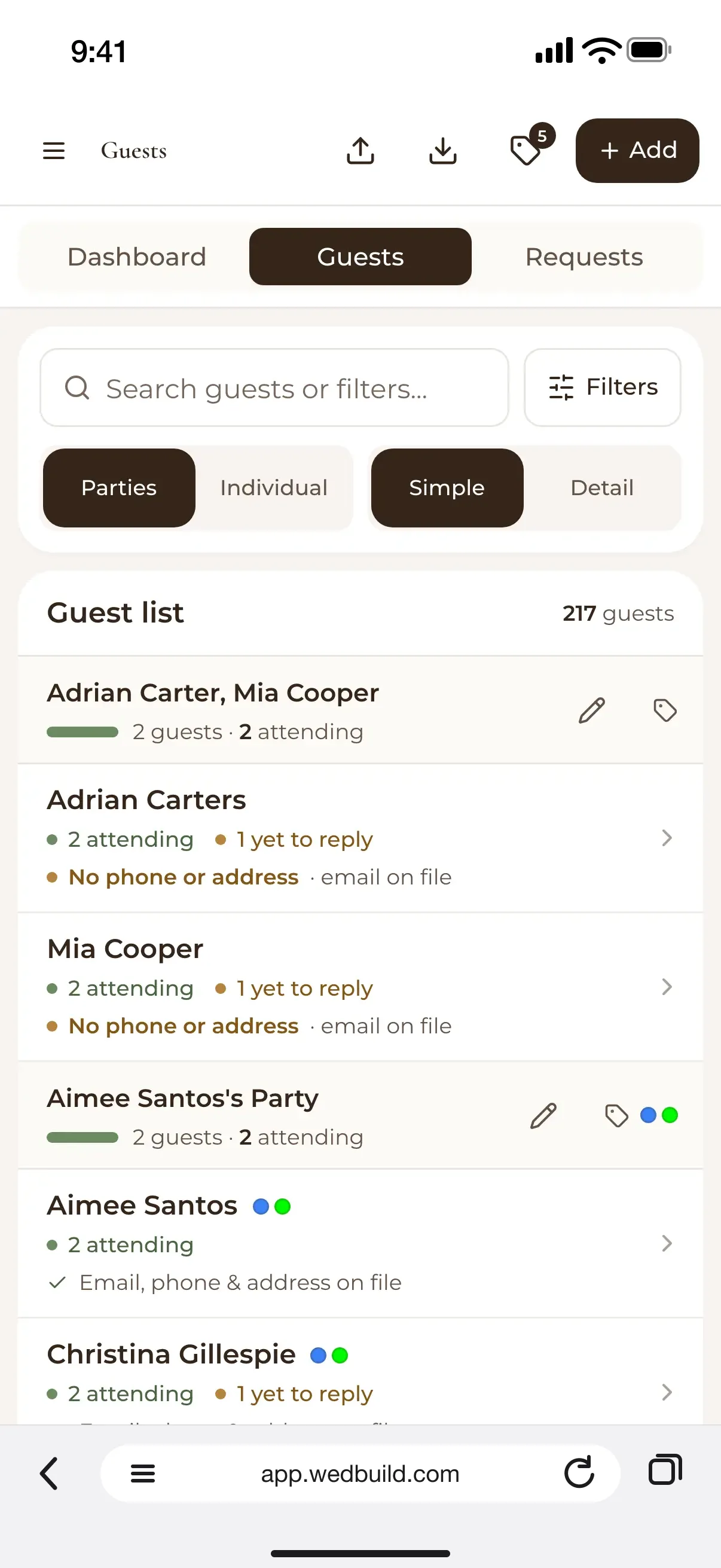
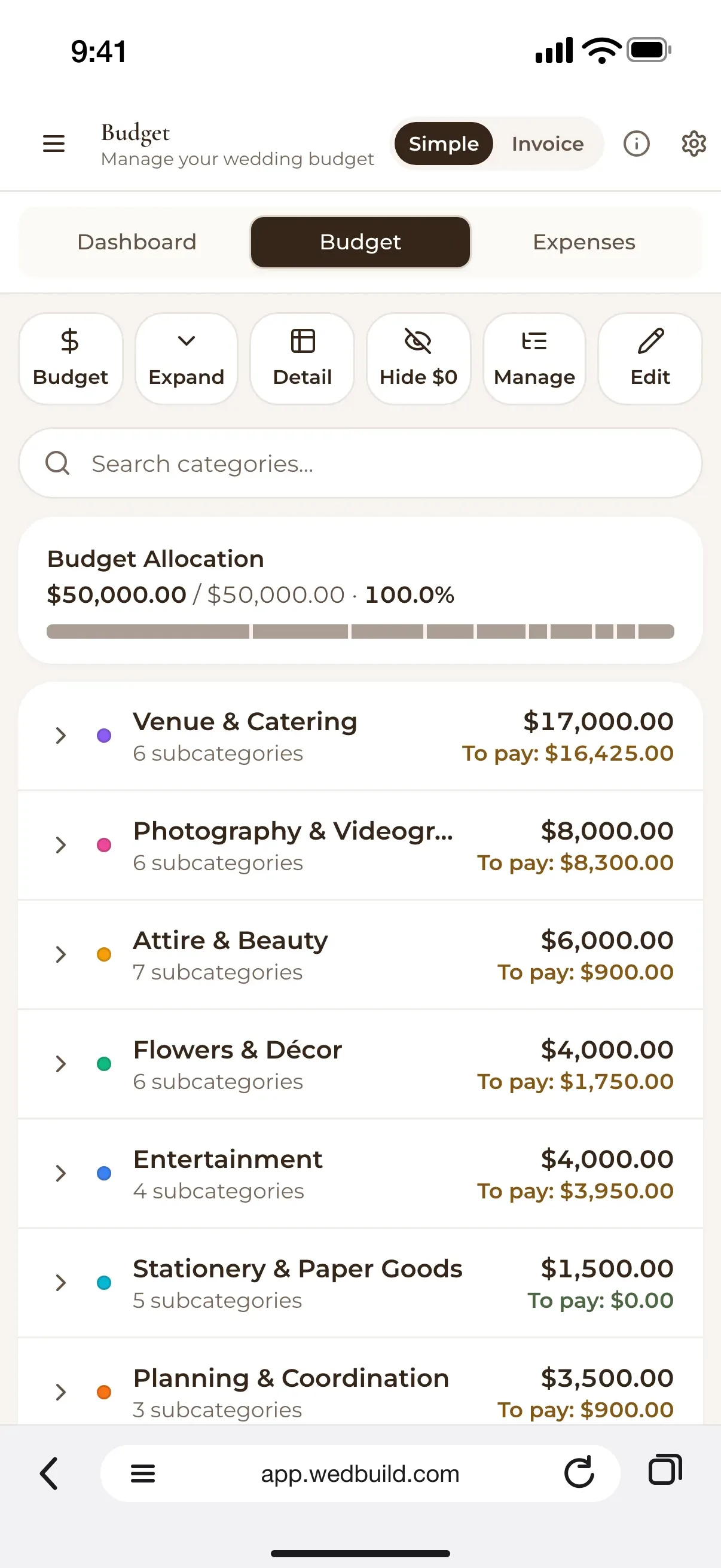
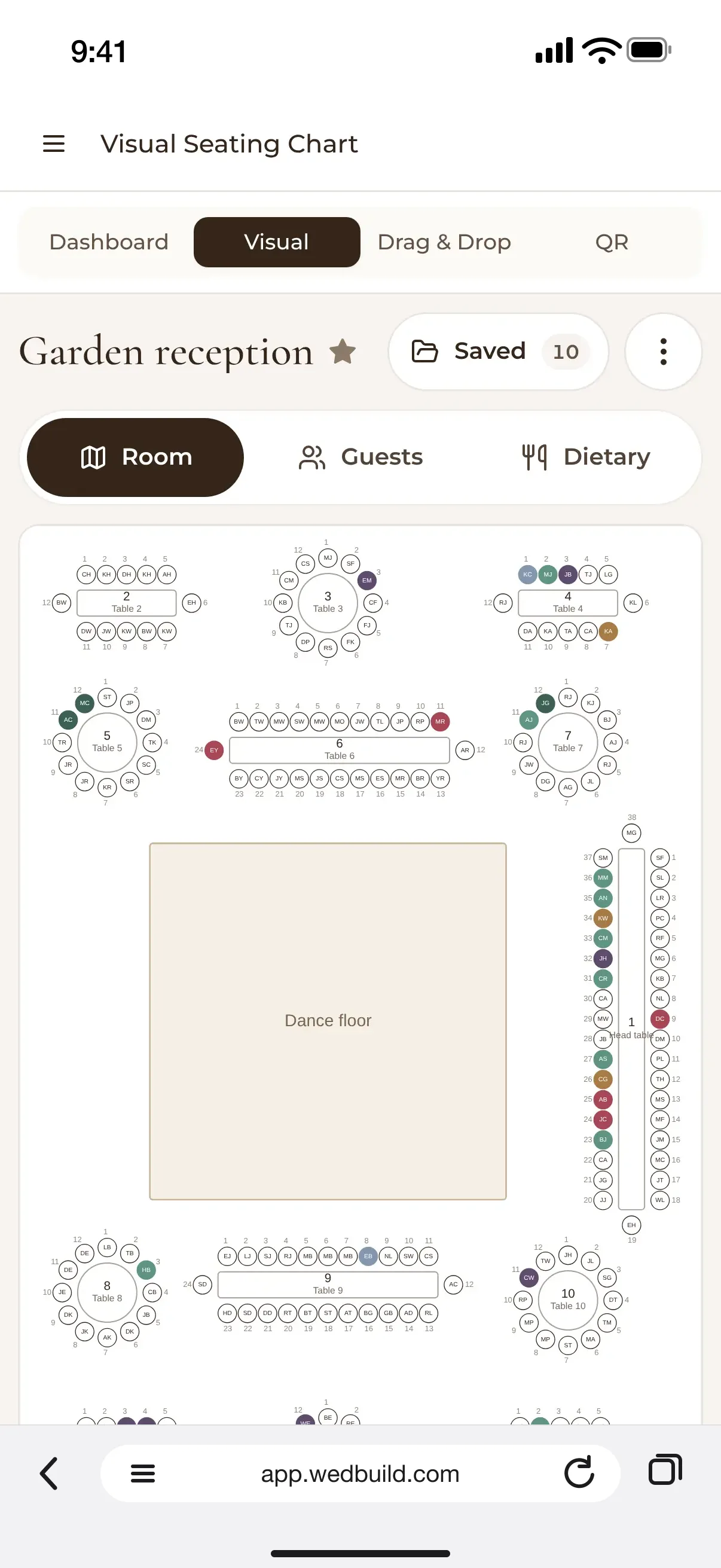
A connected RSVP tool is the stronger fit for lists of 50 or more, mixed dietary needs, or couples who want less manual work. When dietary requirements are collected with the RSVP and passed into the seating chart, there is no need to match them up in a separate step. WedBuild keeps the website, RSVPs, guest list and seating chart in one connected app, so confirmed numbers flow into seating without being re-entered by hand. It is one option for couples who want those tasks joined up.
Its online RSVPs are available on the free plan, while Standard and Pro include the three-reminder schedule sent only to households that haven’t replied. Households without email appear on a “Text these” list for WhatsApp or SMS from the couple’s own phone. After the reply-by date, the tool prompts couples to mark non-responders as not coming, give three more days, or leave the status unchanged. The decision still belongs to the couple. Any extra time needs to fit inside the contractual buffer.
What the RSVP process is really protecting, and how to hand it off to a system
Seating can be finalised, dietary requirements reconciled and place cards ordered with confidence. Unresolved replies hold those tasks open. The avoidable stress comes when the RSVP date sits too close to the caterer’s deadline, compressing all the follow-up into the final week. Working backwards from the deadline spreads that work across six to eight weeks instead.
The next step is to put your dates and follow-up plan into the method that fits your guests, whether that is a shared document, paper records or a connected tool. Set the reminders. Leave time to talk with the guests who need it. You don’t have to keep reconsidering every silence. With a clear cut-off and a process for late changes, the caterer and seating chart can work from the same number. Your final weeks can be about the wedding.
Before you go
Frequently asked questions
Which deadline matters most when guests don't RSVP?
The caterer's final-numbers date matters most, because couples typically pay for that guaranteed number even if guests drop out. Set your RSVP deadline at least two to three weeks before it.
How many reminders should I send?
Three reminders before the deadline are enough: one three weeks out, one a week out and one two days out. After that, call persistent non-responders personally.
What should I do if a guest still hasn't replied after the cut-off?
Count them as not attending, but say so in writing before you enforce it. For close friends and Tier One guests, make a personal call first.
Can I add a guest who replies after the numbers are locked?
Check your contract and contact the caterer or venue before promising a place. Some caterers allow a few additions shortly before the wedding, while others stick to the number given.

Written by
Elise Schofield
Co-founder, WedBuild
Elise is the co-founder of WedBuild and a newlywed who knows exactly what it’s like to be buried in wedding spreadsheets. Frustrated with outdated websites and messy planning tools, she helped build WedBuild so couples can plan their weddings with less chaos and more “this actually feels fun".